
CS2 trade-up contracts: rules, the float formula and real profit
A trade-up contract is the only way to turn ten cheap skins into one expensive one without opening a case. The rules are strict and fully deterministic: the rarity of the inputs, their number, their collections and their average float decide the list of outcomes, the odds of each one and the wear of whatever drops. This guide has the rules from Steam Support and Valve patch notes, the honest float formula with normalisation, how odds split across mixed collections, and a live list of contracts that are profitable at current market prices.

In short: what a trade-up contract is
- 10 skins of one rarity → 1 skin of the next rarity. Steam Support puts it literally: ten normal or StatTrak™ skins of the same rarity trade for one skin of the next highest rarity from one of the collections used in the contract.
- Normal and StatTrak™ never mix. All ten inputs are either normal or StatTrak™. StatTrak™ in means StatTrak™ out.
- Souvenirs are allowed now. Since the 22 May 2026 update souvenir items can be selected alongside normal ones, but every souvenir attribute is stripped and the result is a normal item.
- Covert cannot go into a regular contract. Neither can items that are already the rarest in their collection. Since 23 October 2025 there is a separate contract instead: 5 Covert items → a knife or gloves.
- The output wear is calculated, not rolled. Only the item itself is random; its float follows directly from the average normalised float of the inputs.
- Items received in a trade are locked for a week. For 7 days they cannot be consumed, modified or transferred — so they cannot go into a contract.
The rules: what can go into a contract
The rules come from the Steam Support article CS2 — Trade Up Contracts. They are short and leave no room for interpretation.
- Exactly ten items. Nine or eleven will not be accepted. The single exception is the five-Covert knife contract below.
- One rarity. All ten inputs are Mil-Spec, or all Restricted, or all Classified. Tiers cannot be mixed.
- One quality. Either all normal or all StatTrak™. “Normal weapon skins cannot be used in a Trade Up Contract with StatTrak™ weapon skins and vice versa” is a direct quote.
- Souvenirs work, but stop being souvenirs. The 22 May 2026 patch note: “All Souvenir attributes will be removed from any souvenir items selected, and the result of a Trade Up Contract will be a single normal item of a quality one higher.”
- Covert and “rarest in the collection” cannot be used. Steam Support gives the example of the R8 Revolver | Amber Fade: nothing sits above it in its collection.
- Knives and gloves are not valid inputs. They are rare special items with no tier above them.
The outcome always comes from a collection one of the inputs belongs to. A contract is therefore not a lottery for “some skin one tier up” — it is a draw from a known list: look at the collections of your ten items, list their next-rarity skins, and that is the entire outcome pool.
Six tiers: what turns into what
| Input | Output | Items needed |
|---|---|---|
| Consumer (white) | Industrial (light blue) | 10 |
| Industrial (light blue) | Mil-Spec (blue) | 10 |
| Mil-Spec (blue) | Restricted (purple) | 10 |
| Restricted (purple) | Classified (pink) | 10 |
| Classified (pink) | Covert (red) | 10 |
| Covert (red) | Knife or gloves | 5 |
The last row arrived on 23 October 2025. The patch note: five Covert quality items can be exchanged for one knife or one gloves item from a collection of one of the items provided, and five StatTrak™ Covert items give a StatTrak™ knife. The Steam Support article has not caught up and still says Covert items cannot be used — trust the patch note and the game itself.
Every tier has its own page with collections, input counts and the cheapest entry: Mil-Spec → Restricted, Restricted → Classified, Classified → Covert, Covert → knife.
The float formula: the core mechanic
The item is random, the wear is not. The game computes it in three steps, and you can reproduce the result on a calculator.
- 1 Normalise every input
Each skin has its own float range. The normalised value is
n = (float − min) / (max − min). A float of 0.20 on a skin capped to 0.15–0.90 gives n = (0.20 − 0.15) / 0.75 ≈ 0.067. - 2 Average them
Add the ten normalised values and divide by ten. The result is one number between 0 and 1 — the quality of your basket.
- 3 Map it onto the output range
The outcome float is
output min + average × (output max − output min). Every possible outcome has its own range, so the same basket lands in a different wear for different outcomes.
| Wear | Float range | What it means |
|---|---|---|
| Factory New (FN) | 0.00 – 0.07 | Clean skin with no visible wear |
| Minimal Wear (MW) | 0.07 – 0.15 | Almost clean, scuffing on the edges |
| Field-Tested (FT) | 0.15 – 0.38 | The most common and most liquid wear |
| Well-Worn (WW) | 0.38 – 0.45 | Noticeable damage to the pattern |
| Battle-Scarred (BS) | 0.45 – 1.00 | Heavily worn |
The boundaries are the same for every skin, the available wears are not: if a skin caps at 0.08 it only ever exists in FN and MW. Ranges, caps and why two Field-Tested copies look different are covered in Float, wear and patterns.
Odds: how collections split the probability
Every input brings its collection into the contract. The chance of a specific outcome is the share of inputs from its collection, split evenly between all next-rarity items in that collection.
Formally: chance = (inputs from the collection / 10) / (outcomes in the collection). Which gives a non-obvious rule: the poorer a collection is in outcomes, the higher the chance of each one.
| Basket | Collection A (3 outcomes) | Collection B (2 outcomes) |
|---|---|---|
| 10 from A | 33.3% each | — |
| 7 from A + 3 from B | 23.3% each | 15% each |
| 5 from A + 5 from B | 16.7% each | 25% each |
| 2 from A + 8 from B | 6.7% each | 40% each |
Contracts in profit right now
We scan collections, wears and mixes against live market prices and keep the contracts whose expected value beats the cost of the inputs. The list moves with prices — these are not evergreen recipes but a snapshot of the market.
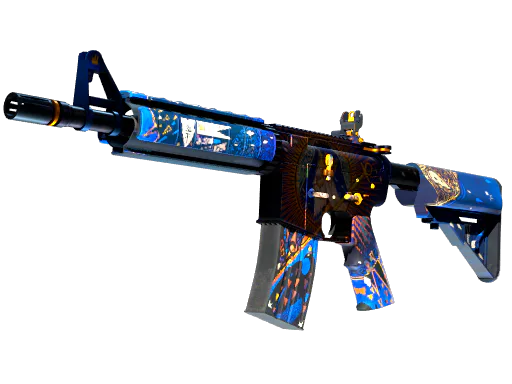 M4A4 | The Emperor $244.92 · 50% Inputs $123.50 Expected $137.28 +11% Chance in profit 47% Build →10× 기밀 → 은밀
  M4A1-S | Chantico's Fire $242.31 · 50% Inputs $144.90 Expected $157.79 +8.9% Chance in profit 47% Build →10× 제한됨 → 기밀
 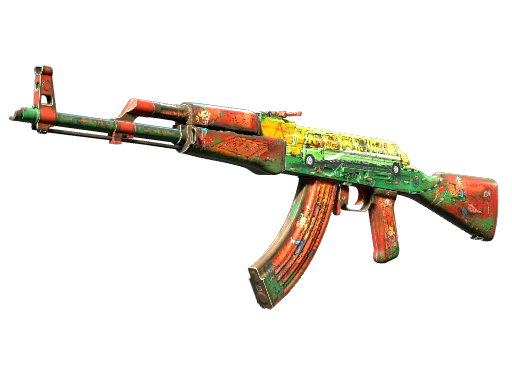 AK-47 | The Outsiders $57.99 · 33% Inputs $25.10 Expected $29.25 +17% Chance in profit 33% Build →10× 제한됨 → 기밀
 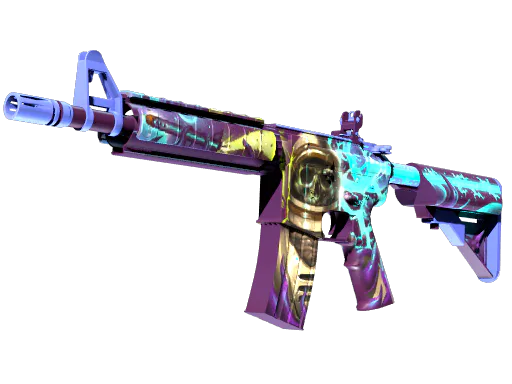 M4A4 | Desolate Space $74.30 · 3.3% Inputs $25.28 Expected $29.02 +15% Chance in profit 32% Build →10× 산업 등급 → 군용 등급
  AK-47 | Green Laminate $36.13 · 7.5% Inputs $6.39 Expected $8.70 +36% Chance in profit 47% Build →
176289 contracts scanned, 119 in profit.
Cost is the sum of ten (or five) inputs at the best market offers. Expected value is the sum of outcome prices weighted by their odds, minus a baseline 10% sale fee. Chance in profit is the probability that a single roll pays the inputs back. Prices are live: by the time you assemble it a contract may be underwater.
The builder takes your own inputs, lets you pick the wear and shows how the expected value moves with the average float.
Open the builderReading profit: expected value, ROI and the chance in profit
A single “profit” number does not describe a contract. A contract is a distribution: most rolls return a cheap outcome, a few return an expensive one. Three numbers are needed.
- Expected value (EV). The sum of “outcome price × its chance”, minus the sale fee. If EV beats the cost of the inputs, the contract is mathematically profitable over a long run.
- ROI. The same surplus as a percentage of the money in. Useful for comparing contracts of different sizes.
- Chance of closing a single roll in profit. Usually well under 50%: profitable contracts are often built as “lose a little nine times, win a lot once”.
- Spread. We show the expected value on the worst and the best input float: when outcomes cross a wear boundary, the gap is enormous.
Fees: why everything is counted net
The contract itself is free, but the outcome almost always gets sold — and that is where the cut happens. On the Steam Community Market it is 5% to Steam plus 10% to CS2: out of a notional 100 the seller keeps about 87. Third-party markets usually take 2–8% from the seller, but cashing out is charged separately.
Our numbers use a baseline 10% sale fee — a midpoint between a cheap market and Steam. The exact Steam figures and the formula are in Steam Market fees; a comparison of selling routes is in How to sell skins safely.
- Price the inputs from actual listings, not from a “median”. You have to buy specific lots, and cheap skins rarely have many lots at the float you need.
- Check the liquidity of the outcome. A $20 expected value is worthless if the item takes a week to sell.
- Remember the seven days. A skin bought on the Market cannot be resold for a week — if the contract falls through, the money is frozen.
Five mistakes that cost money
- Averaging raw floats. As soon as one input has a capped range, the raw average lies. Normalise every input.
- Chasing the cheapest input. A three-cent skin at float 0.9 drags the average up until the expensive outcome lands Battle-Scarred and sells for less than the basket cost.
- Ignoring the size of the collection. Ten inputs from a collection with five outcomes give 20% each; from a collection with two, 50% each.
- Counting profit before fees. 10–15% goes on the sale, and that is exactly the margin between plus and minus.
- Feeding in items that are worth more than their skin. Rare patterns and extreme floats carry a premium that the contract simply burns.
The knife contract: 5 Coverts
Since 23 October 2025 there is a separate tier: five Covert items trade for one knife or one gloves item from a collection of one of the inputs. Five StatTrak™ Coverts return a StatTrak™ knife.
- Five inputs, not ten. It is the only contract with a different size.
- The outcome pool is the rare special items of the input collections. Each collection has its own set of knives or gloves, and the odds split the same way: the collection share divided between its rare items.
- Float follows the same formula. Knife ranges are often capped, so the spread of output wears is narrower than it looks.
- The entry cost is high. Five Coverts run into tens or hundreds of dollars, and the variance at that size is not for everyone.
Every collection with knives and gloves, the cost of entry and the expected value at live prices.
Covert → knife tierSouvenirs in contracts
Until May 2026 souvenirs were a dead end: no StatTrak™, no contract. The 22 May 2026 patch note changed that — souvenir items can now be selected alongside normal ones, but every souvenir attribute (the gold tournament and team stickers, the quality itself) is removed and the result is a normal item one tier up.
- It is a pool of cheap low-float inputs. Souvenir versions of common skins often cost less than the normal ones at the same wear.
- The stickers burn with the quality. Feeding in a souvenir with expensive gold stickers just destroys the premium.
- Rarity is read from the skin itself. A souvenir Mil-Spec is still Mil-Spec: ten of them return a Restricted.
What souvenir versions are, where they come from and why their prices swing so hard is covered in Souvenir and StatTrak.
Building a contract step by step
- 1 Start from the target, not the inputs
Decide which item you want and what it costs in the wear you want. Then look for collections that contain it.
- 2 Count the outcome pool
List every next-rarity item in the candidate collections. The fewer outcomes a collection has, the higher the chance of each.
- 3 Pick the floats
Work out which average normalised value lands the wear you need, then hunt for lots around it. The spread across inputs does not matter — the average does.
- 4 Price the inputs from real lots
Not from an average skin price but from the specific listings at the float you need: those are what you will actually buy.
- 5 Compare with the expected value after fees
If EV minus 10–15% is below the cost of the inputs, the contract loses money no matter how pretty the prize is.
- 6 Assemble it in game
CS2 inventory → right-click a skin → “Use With Trade Up Contract”. Ten slots (five for Covert), confirm, and the result lands in your inventory.
Trade-up myths
| Myth | What actually happens |
|---|---|
| The output float is random | No. Only the item is random; the wear is fixed by the average normalised float of the inputs. |
| More expensive inputs give better outcomes | No. The outcome pool depends only on the collections, never on what the inputs cost. |
| Ten items from one collection guarantee the prize | They only guarantee the collection. Inside it the chance splits evenly across every next-rarity item. |
| StatTrak™ can be topped up with normal skins | No. Steam Support forbids mixing in both directions. |
| A contract can be cancelled | No. Confirmation is final and the inputs are gone. |
| Souvenirs cannot be used | Since 22 May 2026 they can. The souvenir attributes are stripped and the output is normal quality. |
질문과 답변
How many skins does a trade-up contract need?
Ten items of the same rarity, all normal or all StatTrak™, with no mixing. One exception: the knife or gloves contract takes five Covert items.
How is the float of a trade-up result calculated?
Every input is normalised against its own range: n = (float − min) / (max − min). The ten values are averaged and the average is mapped onto the output range: min + average × (max − min).
Can collections be mixed in one contract?
Yes. Each collection gets a share equal to the share of its inputs, and that share splits evenly across all of its next-rarity items. Seven inputs from a collection with three outcomes give 23.3% each.
Can souvenir skins be used in a trade-up?
Yes, since the 22 May 2026 update. Souvenir attributes are removed in the process and the result is a normal item of a quality one higher.
Why can Covert skins not be used in a regular contract?
Because nothing sits above Covert in a collection except rare special items. Valve added a separate contract for those: five Coverts trade for a knife or gloves.
Can normal skins produce a StatTrak™ item?
No. Quality is preserved: normal inputs return a normal item, StatTrak™ inputs return a StatTrak™ item.
Can a skin received in a trade go straight into a contract?
No. For seven days after a trade the item is protected and cannot be consumed, modified or transferred. A contract counts as consuming it.
Are trade-ups profitable at all?
Individual contracts do beat their inputs on expected value — those are the ones the live block above lists. The edge only pays out over a series of rolls: for most profitable contracts the chance of a single roll landing in profit is well below 50%.